

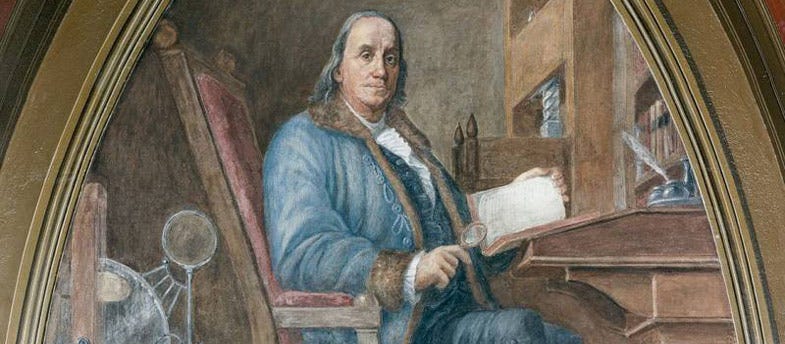
Benjamin Franklin has been dead for two hundred and thirty-six years. Yet he’s still doing PR remarkably well, considering. His face is on the hundred. His quotes are on coffee mugs. He’s got name recognition on par with Taylor Swift, which is more than can be said for most of the other people who signed the Declaration of Independence. (Still waiting for a Broadway show about my man Button Gwinnett.)
This is no accident.
Franklin was, among other things (Founding Father, ingenious inventor, postal service pioneer, avid air-bather, septuagenarian Seine-swimmer, philosopher of flatulence), the first great American publicist.
He ran newspapers. He planted op-eds in other people’s newspapers. He designed viral content back when “going viral” meant a weekend at the leech house. He cultivated his image across two continents for decades, and by the end of his life he was the most famous American alive. (Yes, even more famous than that termite-toothed titan, the bane of cherry trees, George Washington.)
Just about every PR move Franklin made still works. Here are five of them.
1. Find the Right Messenger
In 1722, a sixteen-year-old Ben Franklin wanted to write for his older brother James’s newspaper, The New-England Courant. James, like a typical dickish older brother, said no.
So Franklin invented a middle-aged widow named Silence Dogood. She had opinions about marriage, religion, hoop skirts, and the moral decline of Harvard. Franklin wrote fourteen letters as Silence Dogood and slipped them under the print shop door in the middle of the night. His brother would find them in the morning and, assuming they were written by some learned elder of the town, publish them with great enthusiasm. Readers loved her. Several men wrote in offering to marry her, which was likely awkward for them later. Talk about regretted late-night texts…
Over his lifetime, Franklin wrote under a plethora of pseudonyms: Richard Saunders, Busy-Body, Martha Careful, Alice Addertongue, Polly Baker, Anthony Afterwit. Each had their own voice and backstory. He used them to test ideas, attack rivals, advance political positions, and say the things a respectable printer couldn’t be seen saying under his own byline.
The lesson: Your name is not always the best vehicle for your message. Sometimes a customer, an independent reviewer, a journalist, a business partner, or a middle-aged widow you invented who hates hoop skirts can deliver a message better than you can. Pick the voice that serves the message rather than your ego. Franklin understood this as a pimply sixteen-year-old. Many CEOs still haven’t figured it out (cough, McDonalds, cough).
In Franklin’s words (writing as Richard Saunders), “He that falls in love with himself will have no rivals.“

2. A picture is worth a thousand talking points
On May 9, 1754, Franklin published a drawing in the Pennsylvania Gazette of a snake chopped into eight pieces, each labeled with the initials of a colony. Underneath, three words:
JOIN, or DIE.
It was the first political cartoon ever published in an American newspaper - a colonial precursor to Doonesbury. It came with a long, carefully reasoned editorial that Franklin likely spent a lot of time toiling over.
Nobody (except maybe a handful of history nerds) remembers the editorial. Everyone remembers the snake.
America’s first spicy meme, it spread like wildfire and was reprinted across the colonies. Twenty years later, colonists resurrected it to rally against the British. Paul Revere slapped a version on the masthead of the Massachusetts Spy. It came back in the Civil War (used by both the Union and the Confederacy). It can still be found today on T-shirts at truck stop gas stations, right next to the energy drinks and boner pills.
The cartoon wasn’t subtle. A snake chopped in pieces, with an ALL CAPS threat. But then, most things that go viral aren’t subtle. Subtlety is for people who expect to have the reader’s full attention, which is an assumption no communicator should ever make. Especially in the ADHD age of TikTok. What were we talking about again?
The lesson: One memorable image outperforms a thousand well-crafted talking points. If you want your message to travel, give people something they can see, share, screenshot, and meme-ify. Long before Figma, Franklin gave the colonies a logo that the marketing wizzes at Nike could only dream of.

3. Engineer the Story Before You Tell It
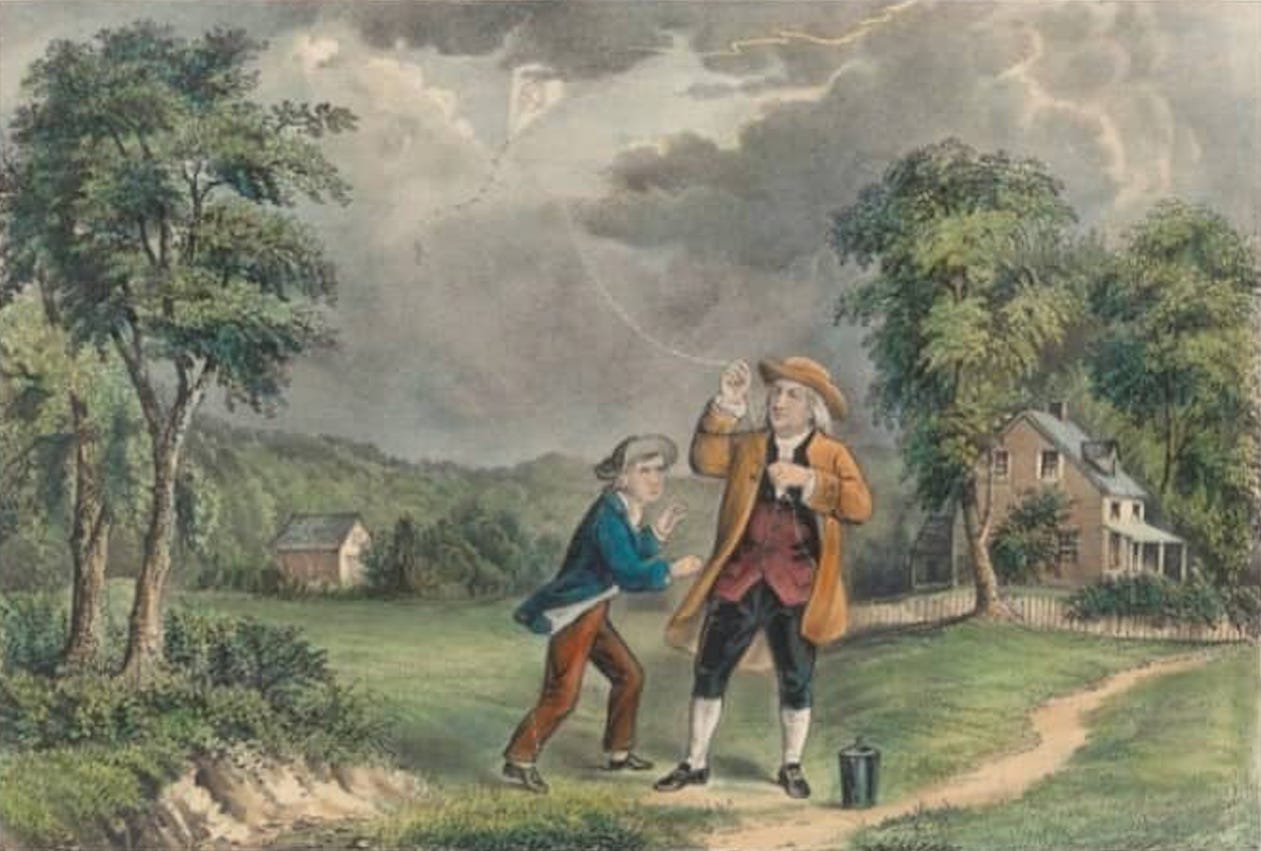
By 1752, the idea that lightning was electrical in nature wasn’t new. Franklin wasn’t the first to suggest it, nor the first to prove it. A French scientist named Thomas-François Dalibard had already run the experiment, using Franklin’s own published instructions and a large iron rod.
So why does everyone know about Franklin and his kite, and absolutely nobody (other than those same history nerds – God they’re annoying) knows about Dalibard and his big rod? Because Franklin had the better story.
He had a kite. People love kites. He had a key. He had a son. He had a big jar for collecting the charge. He had a setting - standing in a doorway as the storm rolled in, with the rain beating down and his mad scientist hair standing on end. When Franklin finally got around to writing it up for the Pennsylvania Gazette, he made sure it read like a scene from a Mary Shelley novel (impressive, since Shelley hadn’t been born yet). Meanwhile, Dalibard’s experiment was about as interesting as a stale baguette.
The lesson: Being first is overrated. Being memorable is not. The people who own a story aren’t always the ones who invented the thing. They’re the ones who packaged it so it could be retold. Raw data isn’t as interesting as you might think. Give your audience a story that gets them genuinely excited. Don’t be a Dalibard, aka Dali-who?
4. Don’t Announce Your Brand. Demonstrate It.
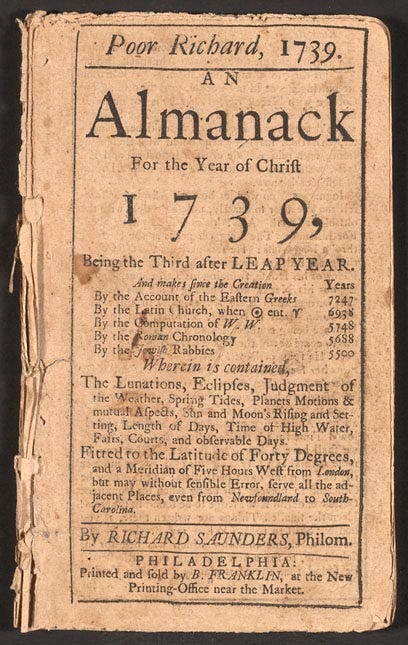
For twenty-five years straight, Franklin published Poor Richard’s Almanack under the pen name Richard Saunders.
As far as pamphlets go, it was a banger. It had everything: weather predictions, tide tables, sunrise and sunset, moon phases, eclipse predictions. Scattered among the tables and forecasts were jokes, aphorisms, and bits of homespun wisdom: Early to bed and early to rise. Haste makes waste. A penny saved is two pence clear. There are no gains without pains. Fish and visitors stink after three days. Countless phrases that have been absorbed into the modern lexicon. I know I say “A penny saved is two pence clear” at least five times a day. My fiancée loves it.
The Almanack sold about ten thousand copies per year. In a country of barely two million people, many of whom couldn’t read, those are blockbuster sales numbers. We’re talking Harry Potter numbers. At the time, it was the most widely read publication in America other than the Bible. And it didn’t even have any magic or talking snakes!
Most of what Americans thought they knew about Benjamin Franklin - the wit, the thrift, the common sense, the folksy wisdom, the whole “I’d have a beer with that guy” persona - came through Poor Richard. Franklin, the actual man, was a sophisticated scientific celebrity (long before Neil deGrasse Tyson) who spoke six languages and hobnobbed with French aristocrats and eminent philosophers. But that’s the point. Richard Saunders was the brand. Benjamin Franklin was the guy running the brand.
The lesson: A personal brand built through useful work lasts longer than one built through self-promotion. Rather than just announcing his values in manifestos, Franklin baked them into a product people happily bought for 25 years. Most LinkedIn thought leadership would benefit greatly from this concept.
5. Coverage Is an Asset. Treat It Like One.
When Franklin’s experiments got written up in London, he made sure Paris heard about it. When Paris said sacrebleu!, he made sure Philadelphia knew. He spread letters, pamphlets, and translated editions across every capital that mattered.
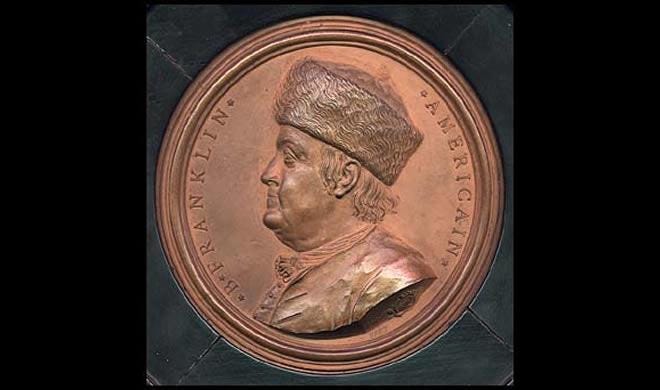
By the time Franklin arrived in France in 1776 as America’s first diplomat, the French had been reading about him for twenty-five years. They greeted him like an international celebrity - which is what he was, because he had spent a quarter of a century seeding the press that made it possible. French women wore their hair in a style called coiffure à la Franklin (really!). His face was on snuffboxes and medallions. He was bigger in France than Jerry Lewis. How did Franklin achieve such a masterful PR campaign? Through years of deliberate consistency.
The lesson: Coverage isn’t a one-time event. It’s an asset to be repurposed, re-planted, recirculated, and compounded. One good mention in the right publication can work for you for a decade if you know how to keep it alive. The most effective communicators are the ones who are consistent and organized about what to do with the hits when they get them.
Whether you’re founding a company or a country, Franklin’s PR playbook is a national treasure worth stealing.
He summed it up best himself, writing (as Richard Saunders, naturally): “If you wou’d not be forgotten, as soon as you are dead and rotten, either write things worth reading, or do things worth the writing.”
Franklin did both. And he made sure everyone knew about it. As I pulled out a fresh hundred to pay for my coffee in San Francisco this morning, I was reminded yet again - it’s still all about the Benjamins.
Want help with PR strategy and execution? Get in touch - that’s what we do at Go West PR. We can’t promise the French will name a hairstyle after you, but we try.